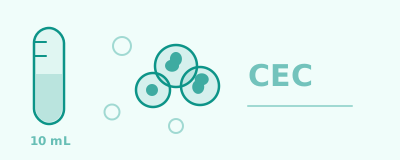
A single 10 mL blood draw, looking for a cell that should not be there in someone healthy. Results in 72 hours. A strong signal to go for a wider vascular workup.
ภาพประกอบเชิงหลักการ ไม่ใช่ภาพถ่ายจากกล้องจุลทรรศน์ — หลักการเดียวกับการตรวจแปปสเมียร์ คืออ่านรูปร่างของเซลล์ ต่างกันที่ตัวอย่างที่นำมาอ่านคือเลือดSchematic illustration, not a microscope image — the same principle as a Pap smear, reading the shape of a cell. What differs is the sample it is read from: blood.
Cells shed from a vessel wall Where a blood vessel is damaged, the endothelial cells lining it detach into the bloodstream. This test collects them from 10 mL of blood and reads them under a microscope.
The abnormality is the clustering, not the presence Ordinary single endothelial cells circulate at low levels in everyone. What is not found in healthy people is cells that are clustered, aneuploid, and abnormally nucleated.
We read the cell, not a number The same principle as the Pap smear, which has used cell shape to flag disease for over seventy years. What differs is the sample it is read from: blood.
จากเลือด 10 มล. ถึงผลตรวจ
1เลือดเฮพารินเจาะเลือดครั้งเดียว 10 มล.
2สลายเม็ดเลือดแดงกำจัดเม็ดเลือดแดงปกติออก
3แยกเม็ดเลือดขาววิธีแยกเฉพาะของเรา
4ย้อมสีเซลล์ย้อมภูมิคุ้มกันหลายสีพร้อมกัน
5อ่านด้วยเซลล์วิทยาอ่านรูปร่างและการติดสี
แยกเซลล์ที่พบได้ยากไม่กี่เซลล์จากเม็ดเลือดหลายพันล้านเซลล์ แล้วอ่านทั้งรูปร่างและการติดสีของเซลล์เดียวกัน X-ZELL พัฒนาทั้งสองส่วนขึ้นเอง ตรวจในกรุงเทพฯ ที่ห้องปฏิบัติการมาตรฐาน ISO 15189 ซึ่งได้รับการรับรองจากกรมวิทยาศาสตร์การแพทย์ — เป็นวิธีเซลล์วิทยาแบบย้อมหลายสีเพียงวิธีเดียวที่ได้รับการรับรอง CE-IVDR และเป็นการตรวจ CEC ที่ได้รับการรับรองเพียงแห่งเดียวในประเทศไทยSeparating a handful of rare cells from several billion blood cells is one problem; reading the shape and the staining pattern of that same cell is another. X-ZELL developed both. Every sample is processed in Bangkok at an ISO 15189 laboratory accredited by the Department of Medical Science — the only CE-IVDR certified multiplex cytopathology method available, and the only accredited CEC test in Thailand.
Blood tumour markers on their own are highly non-specific. A raised value can come from inflammation, infection, or something entirely benign. That is why they should not be used to decide whether a particular disease is present — and why they work as a prompt to look further.
The same is true of an abnormal cell finding. It says something in the body is worth a closer look. It does not say what.
Both are non-specific signals, but they are different kinds of signal — one read from a cell, one measured from a protein. When the two point the same way, your doctor starts from firmer ground than either would give alone. And both lead to the same next step: targeted follow-up rather than a blind search.
Abnormal circulating endothelial cells are not something X-ZELL found on its own. Independent groups in several countries have published on them for decades, and that literature falls into three groups.
Vascular disease Work going back to 1997 found these cells raised in acute myocardial infarction, vasculitis and autoimmune disease. This literature developed entirely separately from the cancer one.
Cancer Reported across more than 13 cancer types — prostate, breast, colorectal, lung, ovarian, liver, pancreatic and others — by unrelated groups in multiple countries.
Healthy people Separate studies exist for the sole purpose of establishing what a normal level looks like. That is what makes it possible to say what counts as abnormal.
If your result is normal No clustered abnormal cells were found. Carry on with your regular check-ups. This is a good sign, not a guarantee, and your doctor can explain what it does and does not rule out.
If your result is abnormal An irregularity was found. That is not a diagnosis, and not a reason to panic — often the cause is very treatable. Your physician will review your health history and suggest targeted follow-up.
Rule out temporary causes History alone excludes most of them: smoking in the last 24 hours, a recent infection or acute illness, major trauma or surgery, and any known blood disorder.
Vascular workup The most likely finding in a wellness population: lipids, hs-CRP, blood pressure, kidney function and HbA1c. See Cardiovascular & TMAO testing.
Wider workup if still unexplained Where the first two steps do not account for the result: autoimmune screening, age- and risk-appropriate screening, organ-specific imaging where indicated, and a repeat test to confirm the finding persists.
No. This is not a diagnostic test for any single disease. An abnormal result says a cell was found that should not be there in someone healthy — which can have several causes, including vascular disease and autoimmune conditions. Your doctor weighs it against your health history to decide what to check next.
Tumour markers measure protein levels in blood. This test reads the shape and staining of actual cells. Neither is specific on its own, which is why this package includes both — they are different kinds of signal and they inform each other.
Avoid smoking for at least 24 hours before the draw — it interferes with the result. If you have recently had an infection, an acute illness, a major injury or surgery, tell our team in advance so we can schedule at a more suitable time.
ทราบผลเมื่อไร?
ภายใน 72 ชั่วโมงหลังเจาะเลือด รับผลผ่านอีเมลหรือ LINE พร้อมคำอธิบายผล
Within 72 hours of the blood draw, delivered by e-mail or LINE with an explanation of what it means.
Typically every 6 to 12 months, depending on your previous result and your own risk profile. After an abnormal result your doctor may suggest repeating it sooner to confirm the finding persists.